












Transform a tiny, expressive planet into a growing civilization—one drag-and-drop building at a time.
Evolution is a charming browser-based strategy game where you develop a living, rotating planet by placing buildings directly onto its surface. Instead of managing complex menus or spreadsheets, you select structures from the bottom of the screen, drag them onto the planet, and watch the world react with new animations, expressions, and visual changes.
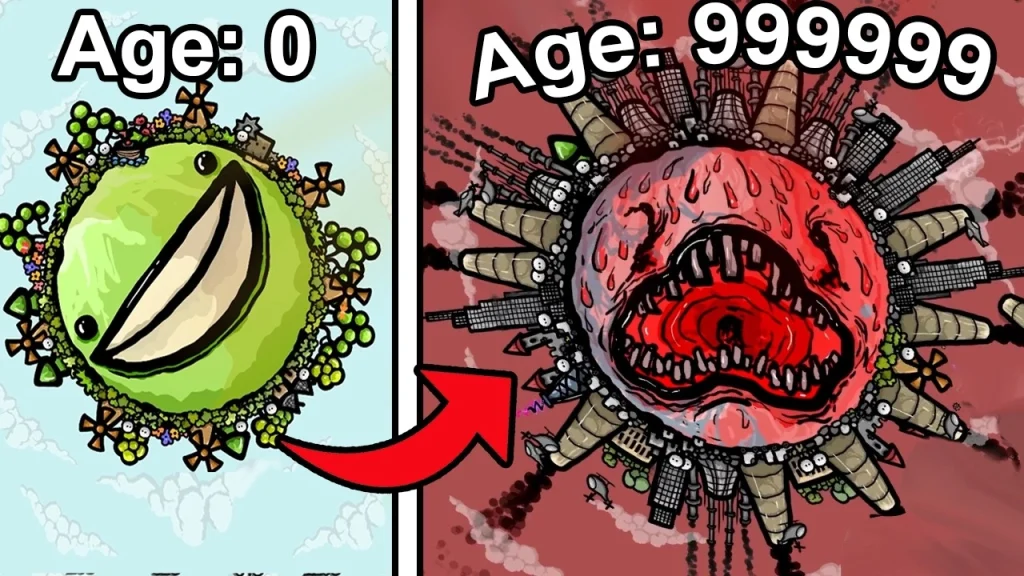
Your journey begins with a natural green landscape and a sunlight resource counter in the top-left corner. As you progress, the planet evolves from a pastoral world filled with trees and flowers into a denser civilization featuring houses, workshops, castles, boats, factories, towers, and other industrial structures.
Evolution Gameplay
Developer: Noah
Made for LD42
Progression Loop
The game starts with a windmill costing 10 sunlight. Further structures appear along the bottom progression bar with rising costs, including 20, 40, 80, 160, 320, 640, 1,280, 2,560, 5,120, and 7,500 sunlight.
Each new building represents another step in the planet’s development. Early structures include windmills, houses, and workshops. Later options introduce castles, boats, industrial facilities, oil-rig-like structures, skyscrapers, and large modern towers.
The challenge is not traditional combat or diplomacy. Instead, Evolution focuses on managing limited space and deciding how to build on an already-developed planet.
Game Controls
The main control is drag and drop:
- Click and hold a building icon at the bottom of the screen.
- Drag it onto the surface of the planet.
- Release the mouse button to place it.
Clicking an icon alone does not place the building. The structure must be physically dragged onto the planet.
Successful placements immediately change the planet’s appearance. Buildings remain visible around its surface, while the planet rotates, changes pose, and gradually becomes more developed.
Managing Limited Space
The tutorial explains that there is not enough room for everything, so players should build on top of what is already there. This makes placement more important than simply selecting the cheapest available option.
As the civilization grows, the planet becomes increasingly crowded with structures. Planning where to place new buildings helps preserve the visual shape of the world and makes it easier to follow the transformation from a natural landscape to an industrial civilization.
Tips for New Players
- Remember that buildings must be dragged, not clicked.
- Start with the cheapest available structures to begin the progression.
- Watch the sunlight counter before attempting expensive buildings.
- Use the planet’s existing surface efficiently, as space is limited.
- Place later structures carefully so the planet remains readable as it becomes more crowded.
- Expect the planet to rotate and change orientation after placements; focus on the drop location rather than trying to control the planet directly.
Why Evolution Is Different
A Responsive Living World
The planet is more than a static map. It has a face, rotates during play, and reacts visually as new buildings are added. This gives every upgrade a playful sense of feedback.
Visual-First Progression
The main reward is watching the world change. The game moves from trees, flowers, and windmills to houses, workshops, castles, factories, and towering modern structures. Its thick outlines and colorful hand-drawn artwork give the entire experience a storybook personality.
Simple Civilization Building
Evolution removes many systems found in larger strategy games. There is no verified combat, diplomacy, multiplayer mode, or complex economic interface in the reachable gameplay. Its focus is a relaxing progression loop built around placement, space management, and visual transformation.
Who Is Evolution For?
Evolution is a good choice for casual players who enjoy short browser games, incremental progression, and watching a world develop. It is especially suitable for players who prefer simple controls and strong visual feedback over complicated strategy systems.
Players looking for deep city management, rival civilizations, combat, or a long-term simulation may find the game too limited. Its appeal comes from its compact design and expressive presentation rather than mechanical complexity.
Verdict
Evolution is a memorable little civilization builder with one clear idea: drag buildings onto a living planet and watch it grow. The controls are easy to understand once the drag-and-drop mechanic is clear, while the escalating building costs and limited space provide a modest amount of planning.
Its hand-drawn art, expressive planet, and visible progression make it more engaging than a standard clicker. It is best enjoyed as a short, relaxing browser experience about building, experimenting, and seeing how far a small green world can evolve.